We extend these operators to the tensor product Hilbert space as
Where is the identity operator on the Hilbert space . This means that acts in as per usual, while it keeps the vectors of other Hilbert spaces unchanged. Accordingly, the action of the operator on a vector is (now we neglect the outer product notation):
And it is very similar for as well.
Obviously, the operators and commute and their sum is also an angular momentum operator, because:
The coefficients, or with the other famous notation are called the Clebsch-Gordan coefficients. According to the usual convention, we choose them to be real. Note that the dimension of the subspace in spanned by the states is .
From which we conclude that if . This condition is usually written as the first rule for the Clebsch-Gordan coefficients: ^a8f084
This also implies that for given and , the maximum of the possible quantum numbers is , therefore cannot be larger than , i.e. for .
The case of
Statement:
That is
Or with the notation :
Proof:
On one hand:
On the other hand:
Therefore, using the actions of the tensor product operators:
Where is the zero vector of the Hilbert space . This shows that and , so the statement is correct.
Generating the other states
Decreasing
Now we know that
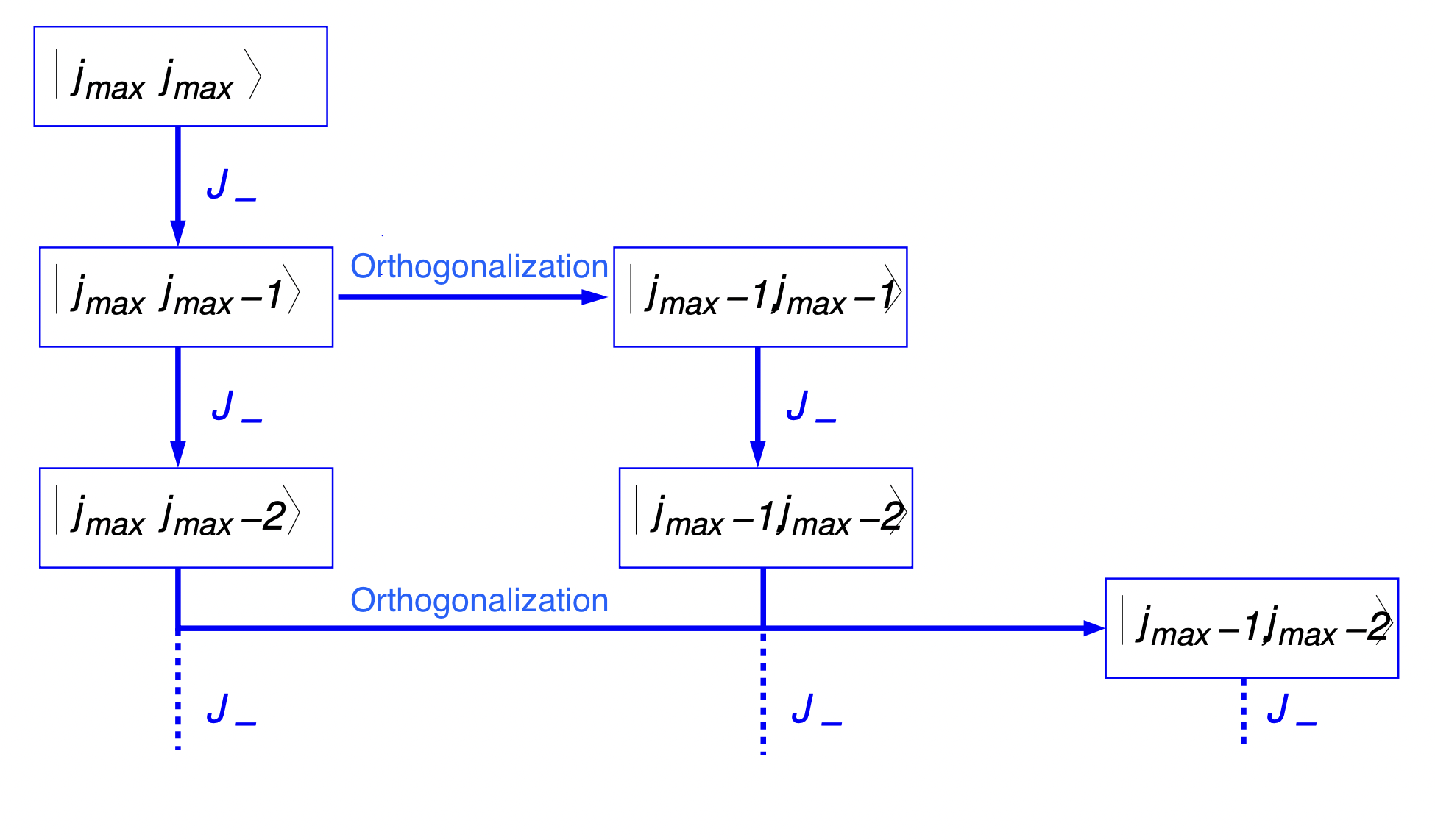
Here we can use the lowering operator to generate the states where . Starting at the state, we use on both sides of the equation:
Then we can successively generate all the states by repeating the shown procedure.
Decreasing
Now that we know how to generate new eigenstates using , we want to be able to decrease as well to get the other states corresponding to the quantum numbers . So we have to construct the eigenstates .
This state can be calculated if we utilize the orthogonality of the eigenstates and , which, as we seen, are the linear combinations of the same tensor product vectors. From the orthogonality of the orthogonality of the eigenstates of and , we obtain:
Up to a multiplicative factor , the solutions of the above two equations is:
Now from this state, we can also generate the states with by the previously shown technique.
Then we can decrease again and find the state by orthogonalizing it to the states and obtained previously and then applying again until we get the state .
The minimal
What is the lowest possible quantum number that we can generate from the states ?
We know that the dimension of the subspace in spanned by the states is , which should be equal to the sum of the dimensions of the eigensubspaces of and that can be generated on this subspace:
There are two possible cases:
is integer (or is odd):
The sum of the odd numbers up to equals
From which
is half-integer (or is even):
Where we used the substitution . Using this identity:
Using any of these, we get the same result:
The possible quantum numbers are then as follows:
Which is usually termed as the second rule for the Clebsch-Gordan coefficients.